Your Roller Coaster Seat Can Change Your Photograph
When you hop on a roller coaster, are you the type who wants to sit in the front row, the back row, or do you just let the ride operator tell you where to sit?
There are photographic opportunities in all three.
As someone who loves taking photographs while riding roller coasters, I've done all of them. I've asked for front row seats. I've asked for back row seats. I've also let the ride operator decide where I end up and then tried to figure out what photograph that particular seat might offer me.
What I've discovered is that when I'm specifically thinking about photography, my favorite place to sit is usually toward the back of the train.
And it has very little to do with the view.
It has everything to do with the people in front of me.
When you're sitting toward the rear of a roller coaster train, you suddenly have an entire train full of people that can become part of your photograph. Sometimes the riders immediately in front of you become the main point of interest. Other times, your eye travels farther down the train toward another group of riders.
The train itself becomes a series of leading lines, with the track, seats and riders all helping direct the viewer through the photograph.
If the train happens to be rounding a curve, it can become even more interesting. Instead of having one person's head completely block the people farther ahead, the curve can open up little windows between the rows and give you a much better view of the other riders.
And there's another benefit that I really enjoy.
The people sitting in front of you are probably strangers.
That means I don't necessarily need to photograph their faces to communicate what they're experiencing. The backs of their heads, their posture, their arms, the way they're leaning into a turn and even the way they hold onto the restraint can tell the story.
You can almost feel what is happening without ever seeing a face.
That brings me to one of my favorite reasons for photographing from the back of the train.
Motion blur.
When you're photographing from the front of a roller coaster, you generally want to use a fast shutter speed if you want to freeze everything. You're already dealing with a moving camera, a moving train and a moving environment, so a fast shutter speed makes it easier to get a sharp photograph.
But from the back of the train, you have another option.
You can slow your shutter speed down just enough to allow the environment around the train to blur while the riders immediately ahead of you remain reasonably recognizable.
The result can look dramatically different.
The landscape outside the train begins to streak past while the riders provide an anchor for the photograph. Suddenly the photograph isn't just showing people sitting on a roller coaster.
It feels like you're actually part of the experience.
You're sitting in that train.
You're moving with them.
You're experiencing the speed.
That's something I think is sometimes missing from photographs of roller coasters. We can take a photograph with a fast enough shutter speed to make everything look perfectly frozen, but a roller coaster isn't a static experience.
People don't get on a roller coaster because they want to sit still.
They want the thrill of movement.
A little motion blur can help communicate that feeling in a way that a perfectly frozen photograph can't.
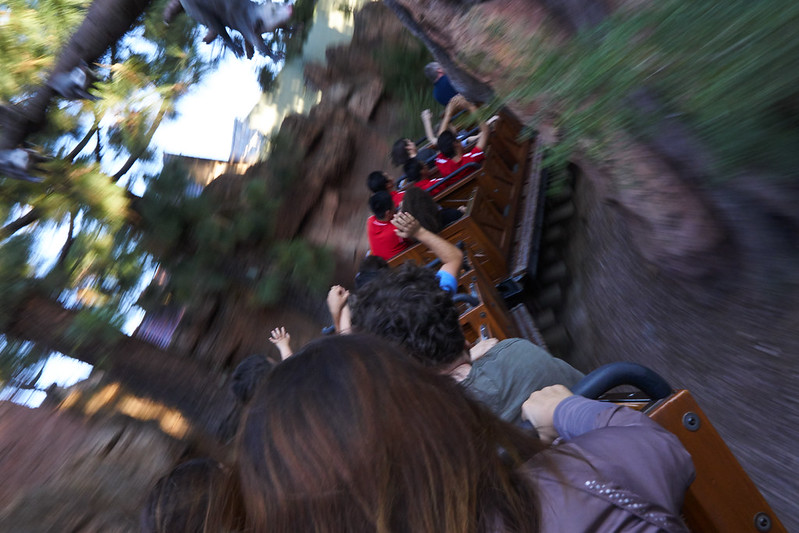
The photograph accompanying this article is one of my examples from Big Thunder Mountain. I was positioned toward the rear of the train and deliberately allowed some of the surrounding environment to blur.
The riders ahead of me help anchor the photograph.
Your eye can move through the train, following the riders and the track, while the surrounding motion blur reinforces the feeling that we're moving quickly through the environment.
It's a very different photograph than I would have created from the front row.
And that's really the larger lesson.
The front row has its own advantages.
From the front, you get an unobstructed view of the track ahead. You can photograph the landscape as it approaches, capture the sensation of dropping toward the track and create photographs where the viewer feels like they are sitting in the very front of the train.
If that's the story you want to tell, the front row makes perfect sense.
The back row simply gives you a different story.
And then there's the third option.
Let the ride operator decide.
Sometimes you don't get to choose your seat, and honestly, that can be fun too.
You might end up somewhere in the middle of the train and discover a completely different photographic opportunity. Maybe the person two rows ahead becomes the perfect subject. Maybe the track curves in a way that creates an unexpected composition. Maybe you suddenly have an unobstructed view of something alongside the ride that you wouldn't have noticed from the front or back.
Instead of thinking, "I didn't get the seat I wanted," you can think, "What photograph can I make from the seat I got?"
That little change in perspective can make you a much more adaptable photographer.
It also gives you an opportunity to experiment.
Try different shutter speeds. Pay attention to what stays sharp and what becomes blurred. Watch how the composition changes when the train enters a curve. Look at the people ahead of you and notice how their body language changes as the ride moves through drops, turns and hills.
And don't overlook the possibility of photographing the riders themselves as part of the story.
A roller coaster photograph doesn't always need to show the attraction as the star.
Sometimes the people experiencing it are the story.
One important consideration whenever you're photographing from a ride is to follow the attraction's photography rules and keep your equipment securely in your hands or otherwise permitted by the park. Don't let getting a photograph interfere with your safety or the safety of other riders. The best photograph isn't worth creating a problem on the ride.
The next time you climb aboard a roller coaster, think about your seat a little differently.
If you're in the front, look for the story that's unfolding ahead of you.
If you're in the back, look at the people, the curves and the motion happening around you.
If you're somewhere in the middle, embrace the challenge of figuring out what that particular seat gives you that the other seats don't.
Your seat doesn't just determine what you see on the ride.
It can determine what story you bring home in your photograph.
I'd love to see what you've discovered.
Come join us in the Fairy Tale Photo Academy community on Skool and share your favorite roller coaster photographs. Tell us where you were sitting, what you were trying to capture and what you learned from the experience.
Because sometimes the most interesting photograph isn't about the ride you were on.
It's about discovering what your particular seat allowed you to see.


