When Tiny Details Steal the Show
When you visit a theme park, it's easy to focus on the big things.
The attractions. The castles. The mountains. The giant characters. The fireworks.
But sometimes one of the best photographs you take is hiding in a place you walk past without giving it a second thought.
Theme parks are filled with little pieces of ornamentation that are easy to overlook. One example you'll find throughout Disneyland is the themed decoration that sits on top of many of the attraction safety signs.
At first glance, they're just safety signs.
And if you're a frequent visitor, they can become almost invisible.
It's a little like the safety information card you find in the seatback pocket on an airplane. If you fly frequently, you probably know there's a card sitting there. You've probably seen it dozens of times. Eventually, you stop paying much attention to it because you've seen it so many times before.
The same thing can happen when you visit a theme park regularly.
You know where the signs are.
You know what they say.
You've walked past them dozens, perhaps hundreds, of times.
So you stop seeing them.
That's exactly why they can become such fun photography subjects.
Disneyland has a wonderful habit of taking something as ordinary as a safety sign and giving it a little bit of personality. Throughout Fantasyland, for example, many of the signs have whimsical decorations that help them feel like they belong in the world around the attraction rather than looking like something that was simply bolted onto the environment because it was required.
And that's where things get really interesting for a photographer.
Some of these decorative elements are beautifully crafted pieces of artwork in their own right. Many of Disneyland's themed signs feature hand carved elements, with much of this work associated with master carver Raymond Kinman.
You might walk past one dozens of times without ever really looking at it.
Then one day you stop.
And suddenly you realize there's a little character sitting on top of the sign that you've never really noticed before.
That's when the sign stops being a sign.
It becomes your subject.
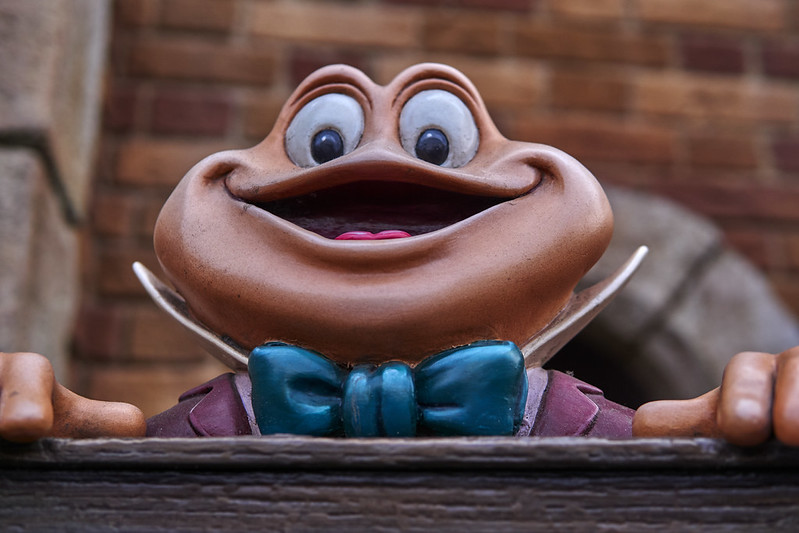
The photograph accompanying this article is a perfect example.
Instead of photographing the entire safety sign, I was interested in the little character sitting on top of it.
Once I started looking at it as a photographic subject rather than a piece of decoration, there were all kinds of possibilities.
I could photograph the entire sign and preserve the context of where I found it. That can be useful in a travel album or even as a heading image for a slideshow.
If you're comfortable with photo editing software, you could even photograph the entire sign and later remove or cover the safety information, replacing it with your own text for a presentation or creative project.
But sometimes I don't want the sign at all.
I just want the character.
That's when I start looking for ways to photograph the tiny detail as though it were the main attraction.
Getting closer can completely change the photograph.
Suddenly the character fills the frame.
The surrounding theme park disappears.
What was once a tiny piece of ornamentation becomes a portrait.
You can also start experimenting with your angle.
With a character that has eyes, one of my favorite things to try is positioning myself so that the character appears to be looking directly into the camera.
It can create the wonderfully silly feeling that you've suddenly caught the character's attention.
You can also move to one side, shoot from below, or change the height of your camera.
Sometimes a tiny change in perspective completely changes the personality of the subject.
And if you happen to have friends or family with you, keep your eyes open for opportunities to incorporate them into the photograph.
Maybe you can frame someone underneath the character.
Maybe you can make it appear as though the character is interacting with them.
Maybe someone can stand beside it so you can play with the scale.
The important thing is that you're taking something that most people are walking right past and giving it your attention.
That's one of the things I love most about photography.
You don't always need access to something rare or exclusive to find an interesting photograph.
Sometimes you just need to actually look at the things you've become accustomed to ignoring.
This is especially useful if you're a theme park passholder.
When you've visited the same park over and over again, you can fall into the trap of thinking you've already photographed everything worth photographing.
You haven't.
You've simply photographed the things you've already trained yourself to notice.
The challenge is to retrain your eyes.
Look at the safety signs.
Look at the decorations around the attractions.
Look underneath things.
Look above your head.
Look at the little pieces of craftsmanship that were added to make the environment feel more authentic.
The more you do this, the more you'll start noticing things you previously walked right past.
And there's a wonderful reward waiting for you when you get home.
Someone will see the photograph and ask, "Where did you see that?"
That's one of my favorite reactions to a travel photograph.
Not because the photograph has to be of some famous landmark, but because it means you've captured something that made the person curious.
You've found a tiny piece of the experience that they may have walked past themselves without ever noticing.
That's when a tiny detail steals the show.
The next time you're walking through a theme park, don't just look for the big photo opportunities.
Look at the things designed to blend into the environment.
There may be a tiny character, a bit of carving, an unusual piece of architecture, or some other little detail that was never intended to be the star of the show.
Maybe it can become the star of your photograph.
I'd love to see what you discover.
Come join us in the Fairy Tale Photo Academy community on Skool and share those detailed signs and little pieces of theme park craftsmanship you've found during your travels. Tell us what you noticed, where you found it, and what made you stop and photograph something that most people probably walked right past.
Because sometimes the best photographs aren't waiting for you at the end of the attraction.
Sometimes they're sitting right on top of the sign you've walked past a hundred times.


