
When a Sign Becomes More Than a Sign
One of the simplest ways to help remember where you've been on your travels is to photograph the signs.
It might not sound like the most exciting photography advice in the world, but signs can become surprisingly valuable pieces of your travel photography collection. Especially in theme parks, where yesterday's familiar location can sometimes become tomorrow's completely different experience.
Theme parks are constantly changing. Attractions are replaced. Restaurants close. Lands are rethemed. Buildings get repainted. Sometimes an entire area that you remember from a particular vacation eventually disappears.
A photograph of the sign can become one of the easiest ways to preserve the memory of what that place was called when you were there.
Sometimes I'll take a quick snapshot of a sign with my phone that I know nobody else will ever see. It isn't intended to be an artistic photograph. It is simply a placeholder that helps me remember the name of a location and gives me a date and time associated with that particular visit.
Later, when I'm looking through my photographs or putting together an album, that little snapshot can help me remember the details of the story I want to tell.
But signs don't have to be relegated to documentation.
They can also become part of the artwork.
When a sign is interesting, beautifully designed, or located somewhere that provides an interesting environment around it, I love incorporating it into a more artistic photograph.
I like to think of these photographs as creating my own postcards.
Instead of simply photographing a sign so someone can read it, I'm trying to photograph the sign in a way that also tells you something about the place where I found it.
This can be especially useful in a photo album. A photograph that includes the name of a location can help divide your album into different sections while simultaneously serving as a photograph that is interesting enough to stand on its own.
The trick is to avoid photographing every sign the same way.
A straight on photograph certainly has its place. Sometimes that's exactly what you need, especially if the goal is simply to document what the sign says.
But if every sign in your vacation album is photographed from directly in front, eventually they can start to feel a little repetitive.
Instead, take a moment to look around the sign.
What happens if you move to one side?
What does the sign look like from a lower angle?
Is there something behind it that could help tell the story of the location?
Could you include some of the surrounding architecture?
Could you use a shallow depth of field to turn the background into nothing more than a collection of colors and shapes?
Sometimes the most interesting photograph of a sign isn't really about the sign at all.
It's about what the sign allows you to include around it.
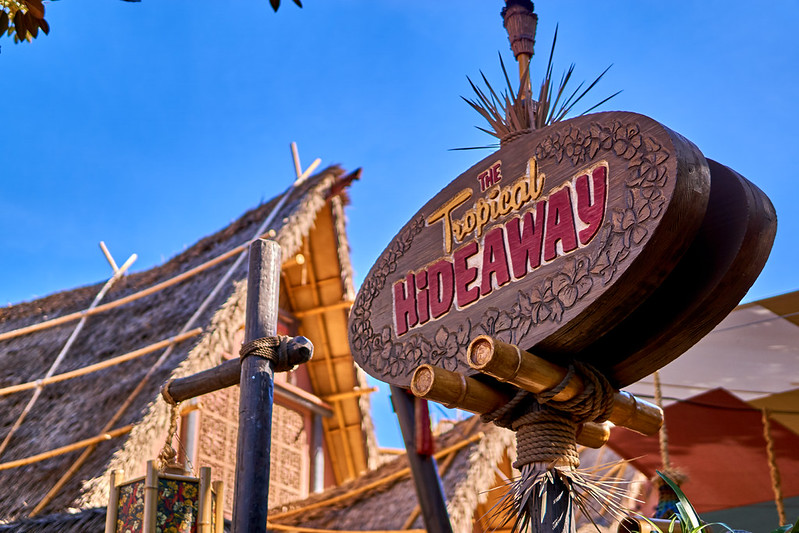
That's exactly what I was thinking about when I photographed the Tropical Hideaway sign at Disneyland.
The Tropical Hideaway sits next to the Enchanted Tiki Room in Adventureland and continues the tropical atmosphere of the area. It's a place where you can grab something to eat or enjoy one of the park's popular Dole Whip treats while surrounded by a setting designed to feel like an exotic tropical destination.
If I had photographed the sign straight on, I would have gotten a perfectly usable photograph of the words "The Tropical Hideaway."
But I would have missed part of the story.
Instead, I moved around to the side and lowered my camera.
That changed everything.
Suddenly, the thatched roof and tropical architecture behind the sign became part of the photograph. Those elements provide visual clues that reinforce the words on the sign.
Now you don't just see a sign telling you that this is the Tropical Hideaway.
You see a tropical looking environment behind it.
The background helps tell you why the location has that name.
I also like what the low angle does to the photograph because it helps eliminate much of the activity that normally surrounds the location. The pathways where guests are walking are mostly hidden below the frame, allowing the photograph to feel a little more like a postcard and a little less like a busy theme park.
There's another detail about this particular angle that I find interesting.
Most guests approaching the Tropical Hideaway from Adventureland are likely to encounter the sign from the opposite side. They see it with the Jungle Cruise environment behind it.
My photograph is closer to the perspective someone might have while exiting the Jungle Cruise and returning to the park.
That isn't necessarily a better view.
It's simply a less common one.
And that's something I encourage photographers to think about whenever they are photographing something that has already been photographed thousands, or perhaps millions, of times.
Don't automatically settle for the view everyone else is going to have.
Look for the view that makes you stop and think, "I haven't seen it photographed quite like that before."
Changing your physical position can completely change the story.
Sometimes it's as simple as taking three steps to the left.
Sometimes you need to get down low.
Sometimes you need to raise the camera above your head.
And sometimes changing the angle of the camera itself can add a little extra visual interest. A sign doesn't always need to have a perfectly level horizon. Tilting the camera slightly can make an otherwise ordinary photograph feel more dynamic.
You can also experiment with depth of field.
With a traditional camera, you might open up your aperture to make the background soft and unobtrusive. With a cell phone, portrait mode can accomplish something similar.
The goal isn't necessarily to make everything behind the sign disappear.
Sometimes having just enough detail in the background to recognize the environment is exactly what makes the photograph work.
You can also use the opposite approach and keep the entire scene relatively sharp.
Think about what you want the viewer to notice first.
If the sign is the star of the photograph, let the background support it.
If the environment is equally important, let the sign become one of the elements that helps tell the larger story.
And don't forget that signs can be particularly valuable when photographing places that are likely to change.
Years from now, you might look at a photograph and remember the sign, the architecture, the colors, or even the particular way guests moved through the area.
Maybe the location will still look exactly the same.
Maybe it will have been completely transformed.
Either way, you'll have a photograph that says more than just what the place was called.
It will remind you what that place felt like when you were there.
That's what makes a sign become more than a sign.
The next time you're walking through a theme park or exploring somewhere new, don't just photograph the signs because you want to remember their names.
Look at what is around them.
Move around.
Change your height.
Change your angle.
Look for an interesting foreground or background.
Try a shallow depth of field.
And ask yourself what the sign could contribute to the story of the photograph rather than simply what information it can provide.
You might be surprised at how often something designed to tell you where you are can also become one of the most interesting photographs from your trip.
I'd love to see what you discover.
Come join us in the Fairy Tale Photo Academy community on Skool and share some of the fun or unusual angles you've found when photographing signs during your travels. Tell us where you were, what caught your eye, and why you chose the angle you did.
The photograph itself is great, but the story behind why you took it can be even better.


