The Human Element: Adding Scale and Emotion to Travel Photos
When we look at a great landscape or travel photograph, our first instinct is often to try to remove people from the scene.
We wait for someone to walk out of the frame. We try to find the perfect moment when nobody is standing in front of the landmark. We may even go to considerable effort to capture that pristine photograph where it looks like we had the entire place to ourselves.
Sometimes that is exactly the right approach.
But there are also plenty of situations where removing people from the photograph actually removes something important from the story.
Sometimes the human element is what tells us just how big, small, tall, or expansive the scene really is.
Theme parks are particularly interesting examples of this because they are masters of manipulating our perception of scale. Designers can make buildings appear taller by deliberately making upper levels smaller. Features can become progressively smaller as they move into the distance. Colors can be changed to create the perception that something is farther away. Even rockwork can incorporate miniature trees near the top to make a mountain or cliff appear much larger than it actually is.
Then there are environments where the goal is almost the exact opposite.
Some theme park attractions deliberately make us feel tiny. Giant props can make us feel as though we have been shrunk down to the size of an insect. Other attractions use miniature environments to tell an enormous story within a relatively small physical space.
Disneyland's Storybook Land Canal Boats are a great example of this kind of miniature storytelling.
All of these techniques rely on something called forced perspective. The environment is deliberately designed to make our brains interpret the size and distance of things differently than they actually are.
Photography can unintentionally undo some of that illusion.
When we photograph one of these environments without anything recognizable in the frame to establish scale, the viewer may have a difficult time understanding just how large or small something really is.
That is where a person can become an incredibly useful photographic tool.
And they don't necessarily have to be the subject of the photograph.
A person can simply become a measuring stick for the viewer's imagination.
Think about a massive mountain vista. You might take a beautiful photograph of the mountains stretching into the distance with absolutely nobody in the frame. It can be a beautiful photograph, but unless the viewer has personally visited that location, it can be difficult to understand the true scale of what they are seeing.
Now imagine that same photograph has a tiny cabin sitting in the foreground or somewhere in the distance.
We already have a pretty good idea of how big a cabin is. We can imagine that an average sized person could stand inside it. Suddenly that enormous mountain behind it feels even more enormous.
Add a person standing near the cabin and the sense of scale becomes even stronger.
The same principle works in cities.
A skyscraper photographed by itself can look impressive, but without anything familiar nearby, the viewer has to guess at its size. Put a person, a car, a streetlight, or even a doorway somewhere in the photograph and suddenly the viewer has something familiar to compare it against.
That familiar object becomes a visual reference point.
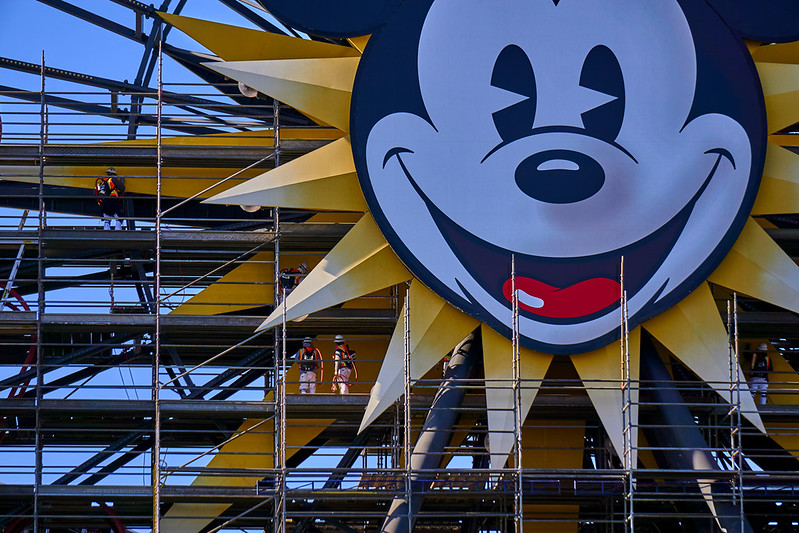
One of my favorite examples of this happened at Disney California Adventure when Paradise Pier was being transformed into Pixar Pier.
The Pixar Pal-A-Round, which many of us knew as Mickey's Fun Wheel, was undergoing its own transformation. Scaffolding had been placed around the giant Mickey face while construction was taking place.
Normally, guests see that enormous Mickey face from across the water. We know it is big, but it is difficult to comprehend exactly how big because there aren't many opportunities to stand next to it.
Then I had an opportunity to photograph construction workers on the scaffolding.
Suddenly the photograph told a completely different story.
The workers were tiny compared with the enormous Mickey face.
The scaffolding itself provided some clues about the scale, but the people made the comparison immediately understandable. We know approximately how tall a person is. We know what a person looks like standing on a platform. We can look at those workers and immediately understand that the giant Mickey face is much, much larger than they are.
For me, the photograph became more interesting because those people were there.
Without them, it would have been a photograph of a giant Mickey face surrounded by scaffolding.
With them, it became a photograph about the scale of the giant Mickey face.
It also became a photograph documenting a very specific moment in the history of the park.
That is another reason I like including people in travel photographs.
People can provide more than scale. They can provide emotion, activity and a sense of place.
A tiny person standing at the edge of a massive canyon can make us imagine what it must have felt like to stand there.
A couple looking out over an enormous landscape can make us feel as though we are standing there with them.
A child staring up at a towering attraction can communicate a sense of wonder without us ever seeing the child's face.
Someone walking through a massive doorway can make the doorway feel enormous.
A person standing beneath a giant tree can make us appreciate how old and immense that tree might be.
The person doesn't necessarily need to be doing anything dramatic.
Sometimes their mere presence is enough.
This is also something worth keeping in mind when you're photographing your own family and friends during travel. We often think of the people we are traveling with as subjects that need to be posed in front of landmarks.
Instead, try photographing them interacting with the environment.
Let them walk ahead of you.
Have them stand near the thing you're photographing.
Wait until they naturally look toward the landscape.
Photograph them from behind as they take in the view.
Suddenly they aren't simply people standing in front of a landmark.
They become part of the story of the landmark.
There is also a practical advantage to using people for scale.
You don't always need to have someone pose for you.
In a busy theme park, you can simply wait for the right person to naturally enter your composition.
If I'm photographing something enormous, I'll often watch the scene for a few moments and look for someone who will enter the frame in a useful location. Sometimes I'll take several photographs while waiting for the right person to reach the right spot.
This can be especially useful when photographing attractions, architecture, mountains, giant statues, trees or other oversized objects.
You can also experiment with where you place that person in the frame.
A person standing close to a massive object can provide an obvious comparison of size. A person farther away can make the environment feel even more expansive. A person positioned near the bottom of the frame can provide a visual starting point that allows the viewer's eyes to travel upward through the photograph.
You don't always want the person to be perfectly centered either.
Sometimes putting them off to one side creates a much more interesting composition while still giving the viewer that important reference point.
And don't forget that people aren't your only options.
Cars, bicycles, benches, doors, windows, streetlights, park signs, trash cans and ride vehicles can all provide recognizable references for scale.
The important question to ask yourself is whether the viewer knows approximately how large that object is.
A familiar object can give your audience something to compare against.
This is one of those photographic techniques that can be especially valuable when you're traveling because we are constantly encountering things that are unfamiliar to the people who will eventually see our photographs.
You may know exactly how enormous an attraction felt when you were standing next to it.
Your audience doesn't.
Your photograph needs to communicate that feeling.
Sometimes the best way to do that isn't by removing everything from the photograph.
Sometimes it's by leaving just one person in it.
The next time you're photographing something enormous, don't automatically wait for everyone to leave the frame.
Look for someone who can help tell the story.
They might just turn an impressive photograph into one that makes the viewer stop and say, "Wow. I didn't realize that was that big."
And that is the power of the human element.
If you've captured a travel or theme park photograph where a person helped you communicate the scale of something, I'd love to see it. Come join us inside the Fairy Tale Photo Academy community on Skool and share your photograph with us.
Even better, tell us what you were trying to communicate with the photograph. Was the person there to show scale, add emotion, become part of the story, or perhaps all three?
Sometimes the person in the photograph isn't the subject at all.
Sometimes they're the reason we understand the subject.


