The Front Row Advantage That Comes at a Photographic Cost
Last week, I made the case that the back rows of a roller coaster train can make for far more interesting photographs than the front row. A few people in my Fairy Tale Photo Academy Skool community wanted some proof, so I promised to share a front row photo of my favorite coaster alongside a similar shot taken from farther back in the train.
Challenge accepted!
I'll start by saying that getting to ride in the front row of a roller coaster is absolutely a thrill. It's well worth asking the attendant assigning rows if you can sit up front. You might have to wait a few extra cycles of the train because it's such a popular request, but when your turn finally arrives, the excitement starts building.
There's no one's head in front of you blocking the view. The track stretches out ahead, and you know what's coming, even if you're not entirely sure how you're going to react when it gets there.
Are you going to throw your arms in the air and embrace the moment? Will you grip the handlebar or restraints with white knuckles, scared out of your mind? Maybe you'll keep your eyes open to watch the scenery race by, or squeeze them shut during the scariest moments.
Perhaps there's a loop that will turn your world upside down, or a steep drop from the highest point of the coaster. Whatever comes next, you know your heart is about to race, and everything will happen so quickly that your mind barely has time to process the experience.
It's an incredible thrill. It's also why so many roller coaster videos on YouTube are filmed from the front row. You get that unobstructed view of the track and the feeling that you're experiencing the ride yourself.
But now let's add a camera for still photos to that front row experience.
Suddenly, you have the ability to freeze time. You can take a moment that lasts only a fraction of a second and examine it for as long as you like. You can explore the details, study the composition, and discover things you couldn't possibly notice while hurtling down the track.
And that's where things get interesting.
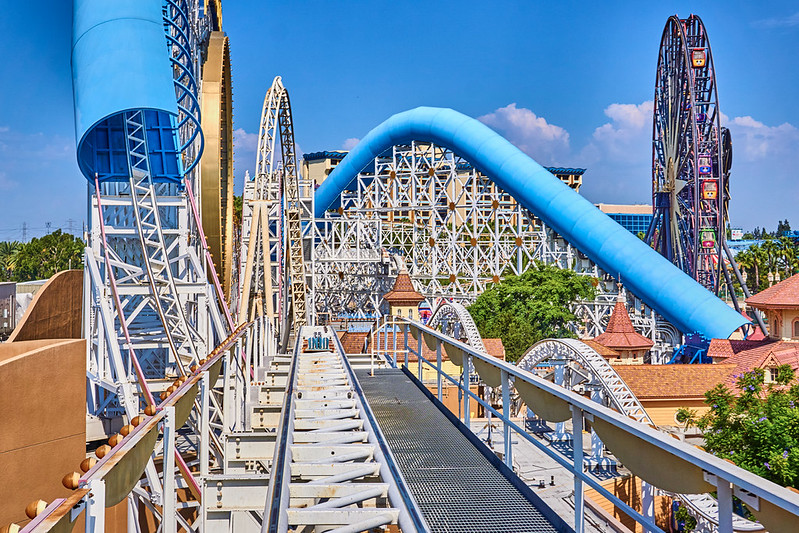
Look at my front row photograph. The track leads your eye forward, disappearing down before the loop rises in the distance. You can imagine what's coming next: being flipped upside down, feeling the forces push you deeper into your seat, and perhaps getting a little dizzy as the track rises toward the next hill before sending you racing down the other side.
That leading line is a great starting point for a photograph. It gives your eye somewhere to go.
But once you've followed the track, where are you supposed to look next?
Without another clear focal point, you begin noticing things that would never cross your mind during the actual ride.
You spot the brake zone and the evacuation platform beside the track, where a coaster train could be stopped if something required it. You notice the rust stains on the white supports. I'm sure the ride is maintained to the appropriate standards, but these are areas where guests don't normally get to stop to look, so those details become much more noticeable when you're studying a photograph.
Then there's the maze of support structures belonging to other parts of the coaster tracks. Your eyes start trying to untangle what's part of the ride, what's another attraction, and what might be a hotel or building in the distance.
There's a lot to look at, but none of it necessarily helps tell the story you wanted to capture.
The photograph might catch your attention for a moment, but it doesn't give you much of a human connection to the experience. You feel alone in that front row seat, looking at a track stretching into the distance.
Where's the adrenaline? Where's the excitement? Where's the sense that you're racing toward something that will turn your world upside down?
Looking at the frozen moment, you might even wonder whether you're actually speeding along the track or sitting stationary while waiting for an attendant to release the restraints. Perhaps you're about to experience a very different kind of thrill: being walked off the attraction during an evacuation!
Okay, that's a little dramatic. But you get my point.
The photograph shows you where you are, but it doesn't necessarily communicate what it feels like to be there.
For comparison, here's another photograph of essentially the same moment, this time taken from the third row of the train.

Ahead of me are two rows of older adults with their arms raised, embracing the experience. They're reaching toward the sky, knowing that in just a moment that sky will become the ground as the train flips upside down.
Suddenly, we have a focal point.
Those raised arms become leading lines of their own, directing our attention toward the track and the loop ahead. We can see where the train is going, but now we also have a sense of who's experiencing the journey.
The people in front of us are no longer obstacles blocking our view. They're part of the story.
We can imagine their excitement. We can almost feel the anticipation of what's coming next. Their body language tells us something about the moment that the track alone couldn't communicate.
Notice how little else matters now. The surrounding structures fade into the background. The evacuation platform and the rust stains if they are even there are obstructed by the rows of people in front of us. They don't get to be part of the story this version of the photo tells.
The human element has changed the photograph.
It gives us context, emotion, and clues about what's happening in the scene. Instead of leaving everything up to the viewer's imagination, the photograph communicates more clearly what I wanted to share.
The two photographs capture essentially the same stretch of track, with the same loop ahead and the same anticipation of what's about to happen. Even though the tunnel colors have changed from blue to red between the two images, the fundamental difference isn't the color or the composition of the track.
It's the story.
So which photograph tells the better story?
I'd love for you to look at both images and decide for yourself.
There's no right or wrong answer. Photography is subjective, and someone else might prefer the clean, unobstructed view from the front row. That's perfectly fine.
For me, though, discovering the photographic limitations of the front row was actually liberating.
When I want to enjoy the full thrill of the ride, I can ask for that front row seat, put the camera away, and immerse myself in the experience. I can raise my arms, feel the wind, and enjoy every twist, turn, and drop without worrying about whether I'm getting the shot.
But when I want to photograph the experience and tell a story that helps someone else feel a little of that excitement, I'll usually look for a seat farther back in the train.
That's where I have a better chance of including the human element that makes the photograph feel alive.
And that's really the lesson here. The best seat for experiencing something and the best seat for photographing it don't always have to be the same.
Sometimes, the people and details that seem to get in the way of a perfect view are exactly what your photograph needs to tell a better story.
Now I'm curious. Which of these two photographs speaks to you more, and what do you think makes the difference?
I'd love to hear your thoughts in the comments or better yet, come join the folks in the Fairy Tale Photo Academy community on Skool. Share your roller coaster photos, tell us the stories behind those unforgettable rides, and connect with other photographers who love finding creative ways to capture the magic of an experience. We have a fun group of people and each week we comment about these article photos.
The best part of a photograph isn't always what you see. Sometimes, it's the story that makes you feel like you were there.


