The Art of Seeing Through Your Subject's Eyes
A traditional way of photographing a subject, whether it is a person or an object, is to photograph the front of that subject and show its face along with whatever happens to be behind it.
People have been doing this for as long as photography has existed.
When we travel, this approach makes perfect sense. We want photographs of ourselves standing in front of the places we have traveled to. They become visual proof that we were there. We stood in front of the castle. We stood in front of the famous landmark. We stood in front of the attraction.
There is absolutely nothing wrong with those photographs.
In fact, you should take them.
But I also like to think about how I can photograph the same subject in ways that tell a different story.
Instead of always photographing the front of the subject, what happens if you photograph it from behind? I talked about this approach in a previous article where I discussed photographing people from behind so that the viewer gets to see both the person and what that person is looking at.
There is another variation of that idea that I really enjoy.
What if you photograph your subject from the side?
Rather than showing the subject straight on, you can find an angle where we get a sense of the subject's profile while also being able to see what the subject is looking toward.
Suddenly, we aren't simply looking at your subject.
We are seeing the world through your subject's eyes.
When your subject is an actual person, this technique can be relatively easy to experiment with. You can move your subject around until you find an interesting combination of light, background and perspective. You can ask them to look in a particular direction and position yourself until everything comes together.
When your subject is something that cannot move, however, you have to do the moving yourself.
That can make the process considerably more interesting.
Take the Esmeralda fortune teller machine at Disneyland, for example.
Esmeralda sits in the entryway to the Penny Arcade on the west side of Main Street, USA. Thousands of people pass by her every day as they make their way through Disneyland.
She isn't completely stationary. She has a little bit of animation built into her experience. When someone puts money into the machine to receive a fortune, her hand moves back and forth before a fortune card eventually appears through a slot below her.
But what really makes her interesting to me is her face.
She sits inside a glass enclosure with windows on three sides, giving guests the opportunity to see her from the front as well as from either side.
She is illuminated by a couple of old style lightbulbs tucked into the corner supports of her enclosure. From the front, those lights help illuminate her and contribute to the atmosphere of the fortune teller experience.
There is also her name, Esmeralda, written across the front glass in an old style font that helps frame her face when you look at her from the front.
That is the view most people are going to photograph.
And it is a perfectly good photograph.
But I started wondering about something else.
What does Esmeralda see?
She spends her days sitting inside that little glass enclosure while the world of Main Street, USA passes by outside.
She has a view.
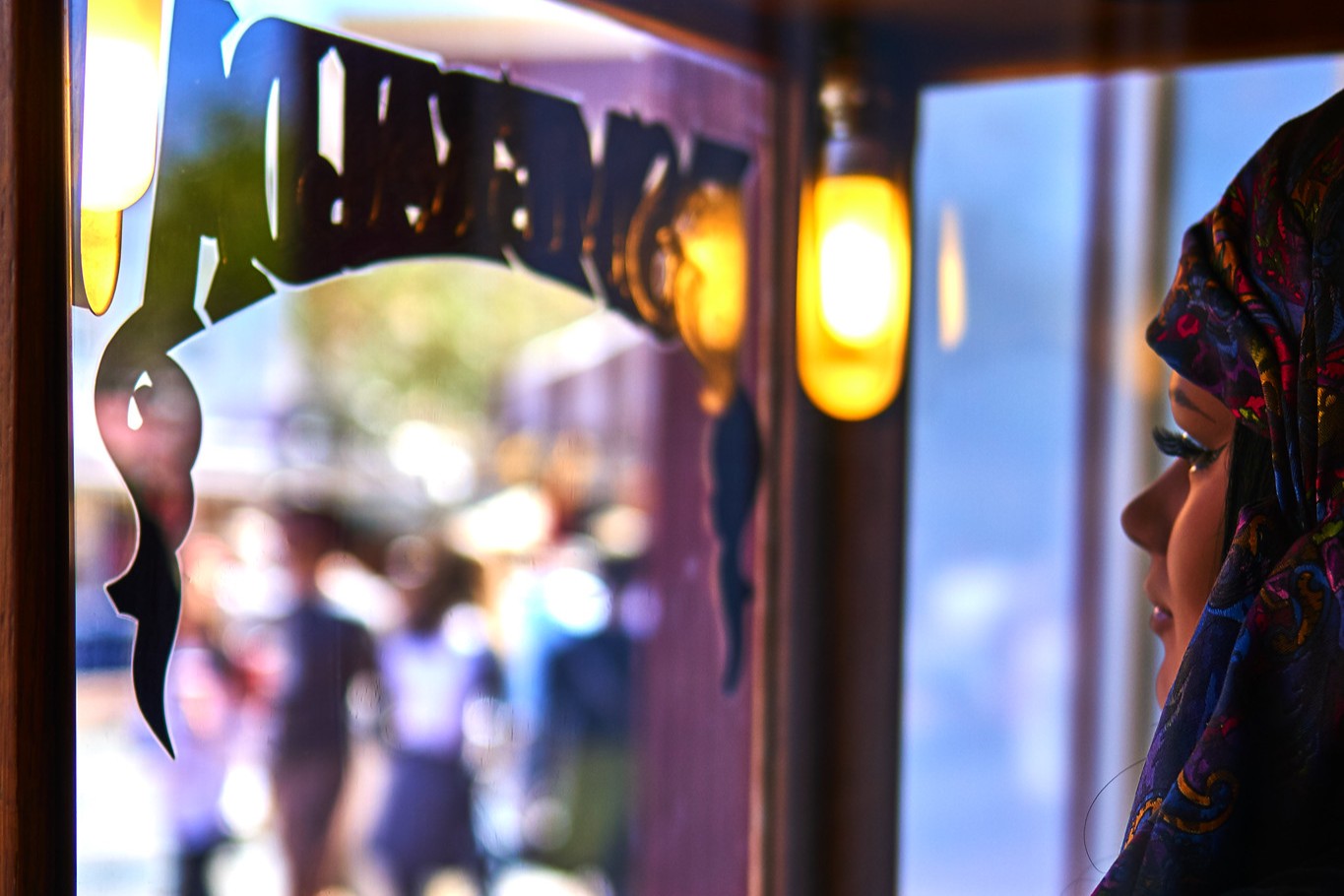
So I moved around to the side of her enclosure and looked at her from a different angle.
Instead of photographing Esmeralda as though she were a portrait subject posing for me, I wanted to photograph her as though I had somehow been given the opportunity to stand inside her little world and see what she sees.
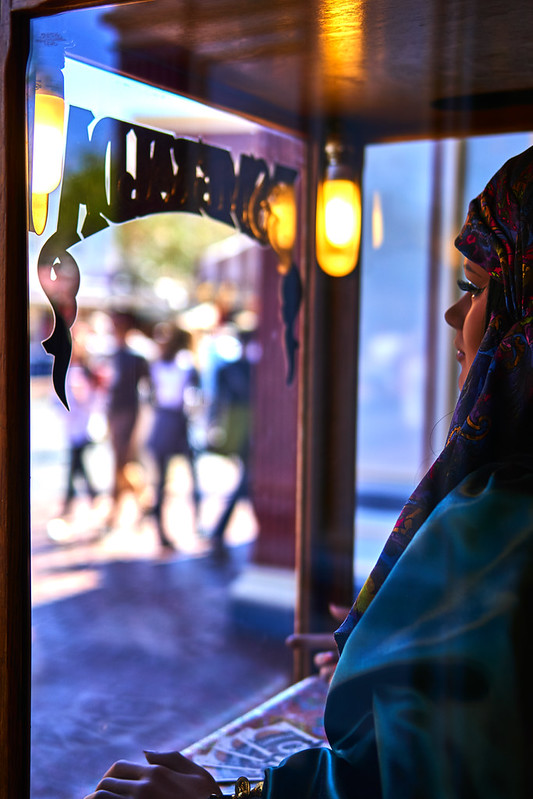
That became the photograph accompanying this article. For a vertical view I've included one at the end of the article.
I particularly like the way the glass separates Esmeralda from the people outside. There is a sense that she is isolated from the crowds while simultaneously being surrounded by them.
She is sitting there waiting.
Waiting for someone to notice her.
Waiting for someone to come closer.
Waiting to tell them their fortune.
I chose to use a shallow depth of field for the photograph, allowing the people and activity on Main Street, USA to dissolve into a colorful blur outside the glass.
We know there are people out there.
We can see the colors and shapes of the world passing by.
But we don't really know who they are or what they are doing.
That was intentional.
The shallow depth of field makes Esmeralda the clear subject while giving us just enough information to understand what she is looking at. It creates a slightly dreamlike quality that makes the photograph feel almost as though we have been transported inside her little enclosure with her.
But there is another version of this photograph that could have been equally interesting.
I could have stopped down the aperture and tried to keep more of Main Street, USA in focus.
That would have changed the story.
Instead of asking the viewer to imagine what Esmeralda might be seeing, I would be showing them exactly what she sees.
The background would become part of the subject rather than simply supporting it.
That is one of the things I love about photography.
There isn't always one correct way to photograph something.
The technical decisions you make can change the story.
The same subject, from the same location, can become a completely different photograph simply because you changed your position or decided how much of the background you wanted to reveal.
And if I had actually had a friend or family member with me that day, I could have taken this idea even further.
Imagine positioning someone so their face appeared through the front window of Esmeralda's enclosure while another person appeared through one of the side windows.
Now the photograph could become a portrait.
The person becomes part of the story while Esmeralda and the world outside become part of the environment surrounding them.
It would almost feel as though the person had stepped into Esmeralda's world for a moment and was looking out onto Main Street alongside her.
That is a very different photograph from simply standing someone in front of the fortune teller machine and saying, "Smile."
And that is really the larger lesson I want to share.
When you encounter an interesting subject, don't automatically assume the most obvious angle is the best angle.
Walk around it.
Look behind it.
Look beside it.
Look above it.
Look below it.
Ask yourself what the subject sees.
Ask yourself what the subject would look like if you were standing beside it instead of directly in front of it.
Sometimes that simple change in perspective can turn something familiar into something fascinating.
There is one particular challenge you may encounter when experimenting with this technique at theme parks.
Glass.
If your subject is enclosed behind glass, you can suddenly find yourself fighting reflections from everything around you. Lights, buildings, the sky and even your own clothing can end up appearing in the photograph.
Sometimes the solution is simply changing your position.
A slight movement to one side can make a reflection disappear.
You can also try getting your lens as close to the glass as practical while still being careful not to bump the glass or the enclosure.
One trick I have found useful is using a jacket or sweatshirt to create a little hood around the front of the lens. By blocking light from hitting the glass around your lens, you can dramatically reduce some of the reflections that would otherwise show up in your photograph.
You don't need expensive equipment to experiment with this idea.
You can try it with a traditional camera or a cell phone.
You can practice it with a friend.
You can find a statue or figure in your neighborhood.
You can photograph a toy sitting on a shelf.
You can even find another interesting object that has a clear direction it appears to be looking.
The important thing is to stop thinking exclusively about photographing the subject.
Start thinking about photographing the subject's perspective.
Because sometimes the most interesting photograph isn't the one that shows us what something looks like.
It is the one that makes us wonder what it sees.
That little shift in thinking can open up an entirely new collection of photographic opportunities the next time you visit a theme park or travel somewhere new.
I'd love to see what you discover.
Come join us in the Fairy Tale Photo Academy community on Skool and share the photographs you have created using an unexpected point of view. Tell us what your subject was, where you positioned yourself and what you were trying to show the viewer.
And if you haven't tried this technique yet, grab your camera or your phone and find something interesting close to home.
Find a subject.
Stand beside it.
Look where it is looking.
Then take the photograph.
You might be surprised by what you see.