
Perfectly Imperfect: Capturing Unexpected Moments in Theme Parks
I would love to tell you that every photo I take is perfectly planned and executed exactly as I envisioned it.
But that would be so far from the truth.
Yes, many of my favorite photographs have come from careful planning. I may have thought about the location, the time of day, the direction of the light, the camera settings and exactly what I wanted to capture. There is something incredibly satisfying about having an idea for a photograph and then successfully bringing that idea to life.
But some of my most memorable photographs have come from something completely different.
Being ready for the unexpected.
When you have your camera ready at a moment's notice, you give yourself the opportunity to capture spontaneous moments that you could never have planned. Maybe a character unexpectedly walks past you. Maybe a mother duck is escorting a group of ducklings across a busy pathway. Maybe the sunlight suddenly hits an ordinary piece of park scenery in a way that makes it look completely different.
You see something.
Your brain says, "That's interesting."
And you have about a second to do something about it.
That is where being prepared can make all the difference.
For me, part of being prepared means keeping my camera easily accessible. I will often have it hanging from a neck strap so I can bring it up quickly when something catches my attention. I also tend to leave the lens hood on rather than putting the lens cap back on between every photograph. The lens hood gives me some protection for the front of the lens while allowing me to be ready to shoot without having to remove a cap first.
There is a tradeoff, of course. You have to be comfortable carrying your camera that way and you need to be mindful of protecting your equipment in a crowded environment. But when something happens in front of you that may only last for a second or two, eliminating unnecessary steps can make the difference between having the photograph and simply having the memory of seeing it.
The same principle applies to photographing with a cell phone.
Knowing how to quickly access the camera from the locked screen can be incredibly useful. Depending on your phone, that might mean using a dedicated camera button, a shortcut on the lock screen, or a combination of the physical buttons that launches the camera.
The goal isn't to become faster just for the sake of being faster.
The goal is to remove enough obstacles that when something unexpected happens, you can concentrate on capturing the moment rather than figuring out how to operate your camera.
These are the "miss it and it's gone" moments.
You don't have time to carefully compose the photograph. You don't have time to analyze every camera setting. You don't have time to make sure everything is perfectly positioned inside the frame.
You see it.
You react.
You take the photograph.
Then you hope you managed to capture something magical.
Sometimes you do.
Sometimes you don't.
And that's okay.
There is another important lesson here that I think photographers sometimes forget.
Not every photograph needs to be a portfolio photograph.
Some photographs are valuable because of the story attached to them.
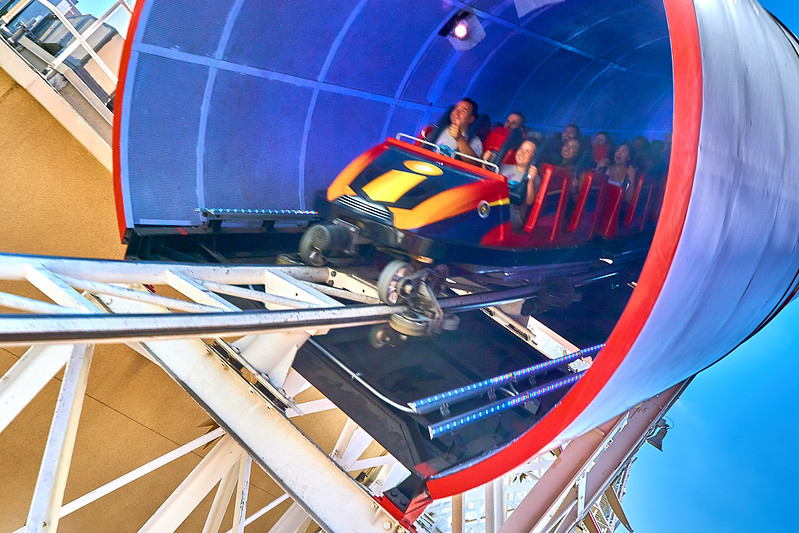
That is exactly what happened with the photograph accompanying this article.
Back when Disney California Adventure's roller coaster was still called California Screamin', I had one of my last opportunities to ride the attraction before it was transformed into the Incredicoaster.
During that ride, I noticed an interesting photographic opportunity from my seat. There was a moment when I could photograph up toward one of the scream tubes and capture the open track and sky beyond it.
After the attraction reopened as the Incredicoaster, I wanted to see if I could recreate that photograph.
This time, however, the scream tube had been enclosed as part of the transformation.
I already knew where I wanted to point my camera. I was essentially waiting for the right opportunity to recreate an idea I had photographed months earlier.
What I wasn't expecting was another roller coaster train to be in the tube.
Suddenly, the photograph I had planned became something completely different.
The important thing is that I didn't have to think about what I was going to photograph.
I was already prepared to photograph the tube.
When I saw the train, I could simply react.
If I had noticed the train first and then tried to figure out where I wanted to point the camera, there is a very good chance I would have completely missed it. By the time I had recognized what was happening, composed the photograph and decided to take the picture, the moment would have been long gone.
Instead, I already had my camera in position. I was already going to take the photograph, but I was expecting an empty tube.
I just pressed the shutter as I was expecting to do and got a nice surprise.
Was it perfectly sharp?
Absolutely not.
I was inside a moving roller coaster train, photographing another moving roller coaster train. There was going to be some motion blur, especially because the second train was completely unexpected.
Is the composition perfect?
Not really.
Would I consider it one of my absolute top tier theme park photographs?
Probably not.
But do I love having it?
Absolutely.
Because now I have a photograph that tells a story.
The track has a few locations where trains can pass relatively close to one another when the attraction is operating with the maximum number of trains on the track. Getting the timing right for one of those encounters is another matter entirely. The trains have to be in the right places at the right time, and operating conditions can make those moments much less common, especially with fewer trains on the track.
I happened to be in the right place.
I happened to already have my camera ready.
And I happened to be looking in the right direction.
The photograph may not be technically perfect, but it captured something I would have otherwise never been able to show anyone.
That's an important distinction.
Sometimes we judge our photographs entirely by technical standards. Is it sharp enough? Is the composition perfect? Is the exposure exactly right? Is there motion blur? Did I get everything in focus?
Those are all useful questions when you are intentionally creating a photograph.
But when you're documenting something that happened for a fraction of a second, the question can be very different.
Did I capture the moment?
Because if the answer is yes, you have something.
You can always wish the photograph had been sharper. You can wish you had composed it slightly differently. You can wish you had used a faster shutter speed.
But you cannot go back and recreate that exact moment.
This is also why I think photographers should be careful about deleting photographs too quickly simply because they aren't technically perfect.
Sometimes the photograph that doesn't impress you when you first see it becomes much more valuable when you remember what was happening when you took it.
Maybe the character was only visible for two seconds.
Maybe the ducklings were never going to cross the pathway again in exactly the same formation.
Maybe the sunset suddenly illuminated something in an extraordinary way.
Maybe two roller coaster trains happened to pass each other at precisely the right moment.
The imperfections become part of the story.
And sometimes those imperfections actually help communicate how difficult the moment was to capture.
A perfectly frozen photograph of a roller coaster can show us what the ride looks like.
A slightly imperfect photograph that captures another trains unexpectedly passing the one I'm in can show us what happened.
There is a difference.
One documents the attraction.
The other documents an experience.
That is why I have learned to appreciate the perfectly imperfect photograph.
It doesn't have to be the photograph I would have created if I had unlimited time, a tripod, perfect lighting and complete control over every element in the frame.
Sometimes I just want the photograph that proves I was there when something happened.
So the next time you're walking through a theme park with your camera or phone, try to keep yourself ready for those unexpected moments.
Don't spend so much time looking for the perfect photograph that you miss the imperfect one happening right in front of you.
Because when the moment arrives, you may only get one chance.
And I'll take a slightly imperfect photograph of a rare moment over a perfectly composed photograph of nothing special every time.
The real question is this:
Would you rather have a photograph that isn't quite perfect but captures a moment you could never recreate, or have no photograph at all because you were waiting for the perfect opportunity?
I'd love to hear your answer.
Come join us in the Fairy Tale Photo Academy community on Skool and share your own perfectly imperfect photographs. Tell us the story behind the photograph, what you were trying to capture, what unexpectedly happened and what makes that photograph special to you.
Because sometimes the best part of a photograph isn't how perfect the picture is.
It's the story you get to tell because you were ready when the moment happened.


