Learning to Wait for the Moment Instead of Chasing It
When you think about photography, you probably imagine having to actively seek out the moments you want to capture. You walk around looking for interesting subjects, explore different locations, and keep your eyes open for something that catches your attention.
And there's certainly plenty of truth to that. But there's another approach to photography that can be just as rewarding: choosing a location, setting up your camera, and simply waiting for something interesting to happen.
It's an approach often associated with street photography. Instead of following people around looking for a photograph, you find an interesting scene, establish your composition, and wait for someone to enter the frame. Maybe they do something that adds an interesting element to the photograph. Maybe they're wearing colors that contrast with the surroundings and make them stand out. Or perhaps their presence simply completes a scene that was missing something.
The interesting part is that you don't necessarily know what you're waiting for. You just recognize that the space has photographic potential and give yourself the opportunity to see what happens.
This can be a particularly useful approach to theme park photography, although it might seem counterintuitive when you consider how most people experience a day at a theme park.
Most guests are on the go, trying to maximize the attractions, shows, and experiences they want to fit into their day. I'll admit I was one of those people for a long time. When you're paying for admission, there's often a feeling that you need to make the most of every minute.
That changed for me when I became an annual passholder at Disneyland.
Having the ability to visit multiple times throughout the year completely changed my relationship with the parks. I no longer felt the pressure to accomplish everything during a single visit. I could slow down, appreciate the scenery, and spend time exploring areas that I might otherwise have walked right past.
I could even show up for just a few hours, enjoy the atmosphere, and leave without riding a single attraction. The value of the visit wasn't necessarily measured by how many things I managed to do.
It gave me more opportunities to stop and smell the roses. Or, in a photographer's case, find a comfortable spot along a pathway, sit down on a bench or wall, and simply watch the world go by.
You might be surprised by how many photographic opportunities come to you when you give yourself permission to stop moving.
One way to approach this is to find a location with an interesting background or composition and wait for people to become part of the scene. You might have a particular architectural detail, a stretch of pathway, or an interesting arrangement of buildings that would make a good photograph on its own. But when the right person enters the frame, the photograph suddenly has a little more personality and a story to tell.
You can make this approach even easier by using a tripod. If you have a relatively out-of-the-way spot where you're comfortable setting up, you can establish your composition and leave the camera ready to capture the scene.
A remote shutter release can be particularly helpful. Depending on your camera, you might be able to trigger the shutter through a wireless connection to an app on your phone, use a small Bluetooth or Wi-Fi remote, or connect a wired remote directly to the camera.
Even some smart watches can be used as remote triggers for a compatible smartphone camera.
A tripod isn't essential, though. It's simply helpful if you want to capture a series of photographs using exactly the same composition. You can just as easily find a comfortable place to sit, keep your camera or phone accessible, and raise it when something interesting enters the scene.
The important part is having a composition in mind and being ready to recognize the opportunity when it arrives.
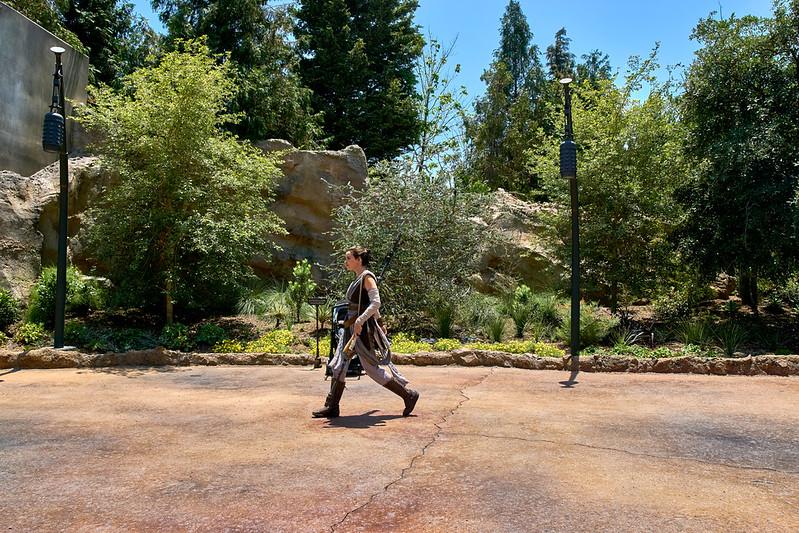
That's exactly what happened with this photograph at Star Wars: Galaxy's Edge in Disneyland.
I had found a spot along a wall beside one of the major walkways through the land. It's an area where guests frequently pass through, often in fairly large groups. Rather than trying to photograph everyone moving through the space, I decided to sit for a while and observe what was happening.
There was something about the wide open pathway and contrast with the landscaping that caught my attention. I thought it might make an interesting photograph if the right subject happened to enter the scene.
And then, almost unexpectedly, a familiar Star Wars character appeared.
Rey, from the sequel trilogy of Star Wars films, was making her way through the area. She was walking through the scene as though she were on a solitary mission, and for a brief moment, the pathway was completely clear of other guests.
I had my wide-angle lens ready, and suddenly I had the opportunity to capture Rey isolated with a significant amount of open space around her to give it the feeling of it being a deserted space.
I was honestly a little surprised by how much open space there was around her. If you've spent much time at Disneyland, you know how unusual it can feel to find a stretch of pathway without a crowd of people filling the frame. Sometimes it feels like you can barely stop to sneeze without someone walking right in front of you!
But there she was, walking through this expansive section of Galaxy's Edge with nobody else competing for attention in the photograph.
It wasn't a major performance or an elaborate character interaction. It was simply a character moving through the environment, and for a brief moment, everything came together to create a photograph that I hadn't planned to take.
The best part was that I didn't go looking for Rey. I didn't follow her around the land or try to find out where she might appear. I had chosen a location that interested me, settled in, and allowed the opportunity to come to me.
That's the beauty of this approach.
When you're constantly moving from one attraction to another, you can miss the little moments happening around you. You're focused on where you're going next rather than what's happening right where you are.
By choosing to stop and observe, you give yourself a different perspective. You begin noticing the rhythm of the environment, how people move through a space, and the occasional unexpected moment that might make an otherwise ordinary scene much more interesting.
You don't have to spend an entire afternoon sitting in one location, either. Even taking ten or fifteen minutes to slow down and observe can make a difference. Find a spot with an interesting composition, watch what happens around you, and see whether something catches your eye.
And don't limit this approach to theme parks. It works beautifully when traveling through cities, visiting historic districts, exploring public gardens, or even photographing your own neighborhood. Anywhere people move through any environment can offer opportunities to let the photograph come to you.
The next time you're out with your camera, consider giving yourself permission to stop chasing the next photo opportunity. Find a place that interests you, take a moment to appreciate the scene, and see what happens.
You might discover that the photograph you weren't looking for becomes one you come back to and think fondly of the moment the photo came to you.
I'd love to hear about the unexpected moments you've captured while simply waiting and observing. Have you ever settled into one location and had something wonderful happen right in front of you? Maybe it was a character passing through an otherwise empty scene, an interesting interaction between guests, or someone whose presence completed a photograph you had already envisioned.
Come join us in the Fairy Tale Photo Academy community on Skool and share your photographs and the stories behind them. It's a great place to exchange ideas, learn from other travel photographers, and discover new ways to see the opportunities waiting around us.
Sometimes the best way to find your next great photograph is to stop looking for it and let it find you.


