Creative Ways to Photograph Tiny Treasures at Theme Parks
When most people think about photography in a theme park, they picture castles, roller coasters, fireworks, or maybe a favorite character. Those are all wonderful subjects, but one of my favorite techniques involves photographing something much, much smaller.
A fun technique you can try during a theme park visit or almost any travel adventure is macro photography. The basic idea is simple. Your subject is very small and positioned very close to your camera lens so that it fills a large portion of the frame. The result is a photograph that makes the tiny object appear much larger than life.
Many photographers immediately think of flowers, butterflies, or insects when they hear the term macro photography, and those are excellent subjects. Personally, I tend to lean toward something a little more whimsical.
I love photographing small toys.
Whether it is a LEGO minifigure, a tiny action figure, a Hallmark ornament, or another small collectible, these little treasures are easy to slip into a pocket or camera bag and bring along for the day. Suddenly your vacation becomes a playground for your imagination.
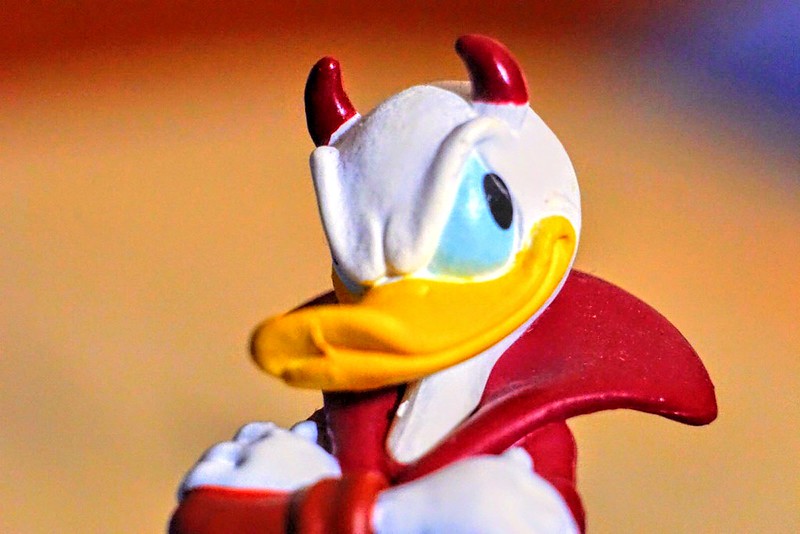
The photo accompanying this article features one of my favorite Disneyland purchases. It is a small Donald Duck "Tagalong" figure dressed as a devil. The set includes both a devil Donald and an angel Donald. Each figure stands on a magnetic base that attaches to a small metal disk hidden under your clothing, allowing Donald to perch on your shoulder as though he is whispering either good or bad advice into your ear.
The figures are only about three inches tall, including their magnetic bases, but when photographed close to the lens they suddenly become the stars of the show.
While wearing them on your shoulders makes for a fun joke, photographing them opens up an almost endless number of creative possibilities. You can photograph them together, separately, or place them into scenes that make it look like they are exploring the park right alongside you.
One of the things I enjoy most about these tiny figures is how portable they are. Unlike larger props, they fit easily into a pocket, making them available whenever inspiration strikes. Because they are so small, you can also photograph them without drawing much attention to yourself. Most guests simply assume you are taking another photo of the park.
One technique that works especially well is forced perspective. By placing the toy very close to your camera and positioning people or buildings farther away, you can create the illusion that your tiny figure is standing shoulder to shoulder with your friends or towering over an entire land in the park.
The secret is paying attention to what appears between your subject and the background. If another object interrupts the illusion, the trick quickly falls apart. Taking a few extra moments to line everything up makes all the difference.
Another approach I enjoy is posing the figure so it appears to be looking out over the landscape. A tiny toy standing on a railing while gazing toward a castle, a mountain, or a famous attraction instantly tells a story. It invites viewers to imagine what that little character might be thinking.
One of the best parts of this style of photography is the beautiful background blur, often called bokeh. By keeping your tiny subject in sharp focus while allowing everything behind it to become soft and dreamy, you naturally draw the viewer's attention exactly where you want it.
If you are using a cell phone, you can often achieve this effect using Portrait Mode. Depending on the phone, you may even be able to adjust the amount of background blur afterward until you find the look you like best. Sometimes I prefer just enough detail to recognize the attraction behind the figure. Other times I blur the background almost completely so only the colors remain, creating a beautiful wash of light behind my subject.
If you use an interchangeable lens camera, dedicated macro lenses are designed specifically for this type of photography. They allow you to focus on subjects that are extremely close to your lens while maintaining excellent image quality.
The downside is that macro lenses can be expensive.
Fortunately, there is another option that is much easier on your wallet.
Extension tubes fit between your camera body and your existing lens, allowing you to focus much closer than normal. They contain no glass, making them an affordable way to experiment with macro photography before deciding whether a dedicated macro lens is worth the investment. For many photographers, extension tubes provide more than enough capability to explore this style of photography.
One tip I would add is to pay close attention to your background before you press the shutter. Since your subject is so small, even moving your camera an inch to the left or right can dramatically improve the colors and shapes behind your subject. A clean background often makes the difference between a nice photo and one that really stands out.
It is also worth experimenting with different camera angles. Instead of always photographing your toy from eye level, try placing your camera down at ground level or tilting it upward toward the sky. Those small changes can make your tiny subject feel much larger and more adventurous.
If you want to try this technique right away but do not have a small collectible, do not let that stop you. Visit a dollar store, a thrift store, check out the toy section at your local grocery store, or even see what is inside a fast food kids meal. If you have children, ask if you can borrow one of their favorite little toys for an afternoon photo adventure. Once you discover how much fun this style of photography can be, you can always add a favorite character or collectible to your own travel kit later.
One of the things I love most about photography is that it encourages us to see familiar places in completely different ways. A tiny toy can transform an ordinary walkway into a grand adventure, and a simple flower bed can become an enchanted forest. Sometimes all it takes is changing your perspective.
If you give macro photography a try on your next theme park visit or even around your own neighborhood, I would love to see what you create. Join us in the Fairy Tale Photo Academy community on Skool and share your favorite macro photographs. Whether you use a phone, a dedicated macro lens, or a simple set of extension tubes, you might be surprised how much creativity can come from the smallest subjects.


