Creating Motion By Standing Still in Theme Parks
When I first started experimenting with long exposure photography at Disneyland, I didn't even own a tripod.
I wasn't sure if I was going to enjoy the technique enough to justify buying one, so I improvised.
I found a trash can near an attraction with moving lights, rolled up a sweatshirt to create a makeshift camera support, and waited for something illuminated to pass by. Then I opened the shutter for a couple of seconds and hoped for the best.
Looking back, those first photos certainly weren't masterpieces.
But they were magical.
For the first time I could see light behaving in a way my eyes never could. Instead of tiny points of light, I had ribbons of color stretching across the frame. Even though the photos were technically rough, they showed me enough potential that before my very next Disneyland visit I had purchased my first tripod.
For the next few trips I could hardly wait for the sun to go down. Every attraction with moving lights became a new opportunity to experiment. Roller coasters, spinning rides, passing trains, anything that moved became my subject.
Then one evening I had a realization.
What if the lights didn't have to move?
What if I moved instead?
That simple question completely changed how I looked at long exposure photography.
Rather than standing on solid ground waiting for something else to create motion, I decided to become the moving element in the scene.
That idea led me straight to the Mark Twain Riverboat.
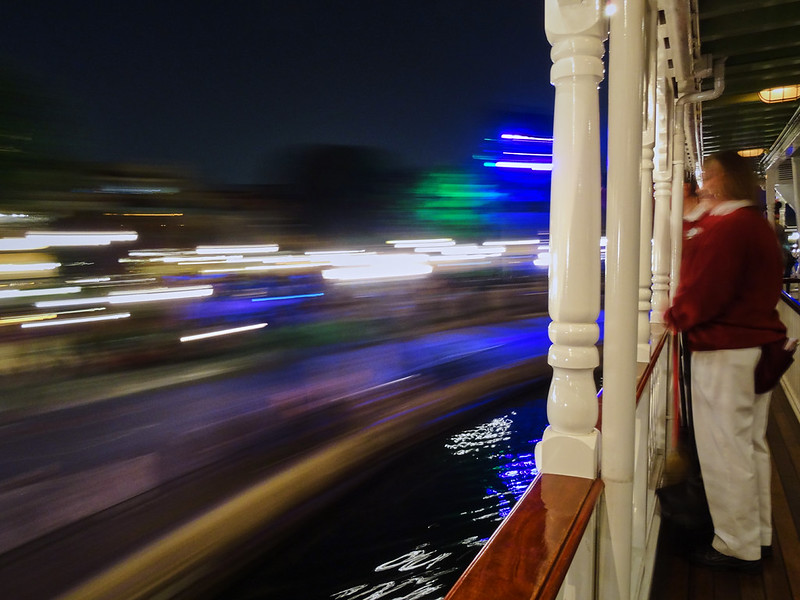
Fortunately, Fantasmic was not performing that evening, so the riverboat was still offering nighttime cruises around the Rivers of America. I climbed to the second deck and found a composition looking through one of the arches toward the glowing lights of New Orleans Square.
I intentionally composed the image so part of the riverboat itself stretched down the side of the frame. I wanted something that would remain relatively sharp throughout the exposure while the lights on shore transformed into streaks of color. Giving the viewer something recognizable to anchor the image makes the motion feel much more dramatic.
As the riverboat eased away from the dock and headed toward the main Fantasmic viewing area, I was ready.
I had my camera mounted securely on the tripod with the shutter set for a two second exposure. My goal was not to create extremely long streaks but just enough movement to show the boat gliding smoothly through the water.
Then something unexpected happened.
A pair of Disneyland custodial Cast Members stepped into one of the archways a few openings down from me to enjoy the nighttime view.
At first I wondered if they had just wandered into my composition.
By the time I reviewed the images later that evening, I realized they had actually made the photograph better.
Because they remained fairly still during the exposure, they appeared just slightly softened while still being recognizable. Their presence added something the scene had been missing.
Life.
Instead of simply being an architectural photograph with light trails, it became a moment. Two people quietly appreciating the beauty of Disneyland at night while the world drifted by around them.
Ironically, the moving riverboat made it feel as though New Orleans Square was racing past us at incredible speed. The light trails almost reminded me of a spaceship jumping into hyperspace in Star Wars or entering warp speed in Star Trek.
That is one of the things I love most about long exposure photography.
It allows you to show movement in ways our eyes never naturally experience.
One of the biggest lessons I learned is that nighttime is actually one of the easiest times to experiment with long exposures. Since the scene is already dark, you usually don't need neutral density filters to reduce the amount of light reaching your camera. If you decide to experiment with much longer exposures, a filter can still be useful for preventing bright lights from becoming overexposed, but for many nighttime scenes you can simply begin shooting.
Don't be afraid to experiment with different shutter speeds. A one second exposure creates a very different feeling than two seconds, and five seconds creates another look entirely. There isn't a single correct setting. The fun comes from discovering which one best matches the story you want your photograph to tell.
Using a tripod is one of the biggest improvements you can make. It allows the parts of your composition that should remain sharp to stay sharp while everything else transforms into flowing light and motion. If your camera has a remote shutter release or a two second timer, use it. Eliminating even the slight vibration from pressing the shutter button can make a noticeable difference.
One thing many photographers overlook is that movement doesn't always have to come from your subject. Sometimes it's far more interesting to photograph ordinary, stationary lights while you're the one in motion. Slow moving attractions like riverboats, trains, observation wheels, and even some transportation rides can become creative tools rather than simply ways to get from one place to another.
Finally, don't forget about composition. Motion is exciting, but your viewer still needs an anchor. A railing, an archway, part of your ride vehicle, or even another guest can provide that sense of stability that makes the moving elements feel even more dramatic. Without something sharp to compare against, the entire image can simply look blurry rather than intentionally artistic.
Some of my favorite photographs have come from asking one simple question.
"What happens if I try the opposite?"
Sometimes the answer is far more interesting than you ever expected.
If you'd like to experiment with long exposure photography or light trails, we'd love to see what you create. Join us in the Fairy Tale Photo Academy community on Skool and share your favorite results. Whether you're photographing a moving roller coaster from solid ground or creating motion while standing still aboard a slow moving attraction, you'll find a community of photographers who love exploring creative techniques together. Bring your questions, share your experiments, and join the conversation. You never know when your next idea might inspire someone else's favorite photograph.


