Borrow the Idea. Create Your Own Masterpiece.
One of the compliments I hear most often is that I have a good eye for photography. People will ask me how I "see" the shots that I take. The answer is probably less exciting than they expect. Like almost any creative skill, it comes from practice.
The more time you spend with a camera, the more you begin to recognize patterns. You start noticing how light behaves, how leading lines pull your attention through a scene, and how changing your position by just a few steps can completely transform a photograph. Over time you develop what I like to think of as your photography muscles. The more you exercise them, the stronger they become.
One of the fastest ways to develop those muscles is by learning from photographers whose work you admire.
If you have an upcoming trip to a particular theme park, spend some time looking through photographs from people who have already been there. Search Instagram, Flickr, or other photography communities and simply enjoy the images. Flickr is especially helpful because many photographers leave the camera settings, camera body, and lens information attached to their images. That extra information can make it much easier to understand how a photograph was created.
Whenever you find an image that really captures your attention, save it somewhere you can return to later. Then ask yourself why it stood out. Was it the time of day? The lighting? The angle? The composition? Was there something about the way the photographer used foreground elements or framed the scene that made it feel different from all the other photos of the same location?
Theme parks are some of the most photographed places on Earth, which makes them incredible places to study photography. You'll see thousands of photos of the exact same attraction, yet only a handful will immediately grab your attention. As you compare them, you naturally begin to understand what makes one image memorable while another simply documents the location.
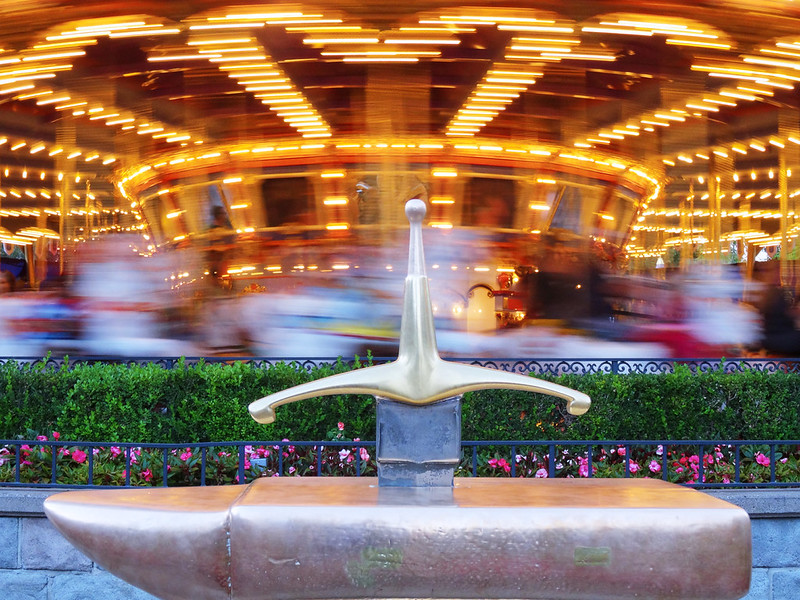
One example that completely changed the way I looked at a familiar spot came from another photographer's image of the Sword in the Stone display in front of King Arthur Carrousel at Disneyland. They had positioned the sword in the foreground while photographing the carousel during sunset with a slightly longer shutter speed. The result was beautiful. The sword remained sharp while the moving carousel created soft streaks of color behind it.
I had walked past that sword countless times, yet I had never considered photographing it that way.
The next time I visited Disneyland, I wanted to create my own version.
Notice I said my own version, not an exact copy.
The goal was never to claim the idea as mine. The goal was to experience the process of creating that type of photograph for myself.
That experience taught me far more than simply looking at the original image ever could.
I quickly discovered that the sword is one of the most popular photo spots in Fantasyland. Families constantly stop to take turns trying to pull the sword from the stone. That meant I needed to be patient. I would wait while guests enjoyed their moment, take a couple of frames when the area cleared, then step aside again if another family arrived. There was no reason to hold up someone else's magical moment just because I wanted another photograph.
I also realized I only wanted to photograph the carousel while it was moving. A stationary carousel simply did not create the same feeling. That meant paying attention to the timing between ride cycles.
To keep the sword perfectly sharp while allowing only the carousel to blur, I set up my tripod and experimented with shutter speeds until I found one that created just enough motion. I wanted the lights to stretch into graceful streaks without becoming complete circles around the carousel.
By recreating the concept, I wasn't simply making a similar photograph. I was learning how and why it worked.
That experience became part of my own creative toolbox.
Now I naturally look for opportunities to use that same technique elsewhere. Maybe it will be another theme park. Maybe it will be aboard a cruise ship. Maybe it will be in the middle of a city halfway around the world. The subject may be completely different, but the lesson stays with me.
That is how photographers grow.
Every artist learns from those who came before them. Painters study the masters. Musicians learn songs before writing their own. Writers read books before telling their own stories.
Photography is no different.
There is nothing wrong with recreating a photograph as a learning exercise. In fact, it is one of the fastest ways to understand composition, timing, lighting, and technique. The important part is that you use what you learn to inspire your own creativity rather than stopping with the copy.
One day someone may see one of your photographs and think, "I want to try that."
Your image could become the spark that inspires someone else's creative journey, just as another photographer inspired yours.
The more you photograph, the more you begin to see opportunities that other people simply walk past. Eventually, those moments that once seemed impossible to notice start jumping out at you. What once felt like talent reveals itself as something much simpler: experience, curiosity, and practice.
Photography really is a skill that rewards those who keep showing up with a camera in hand.
If you've ever recreated a photograph that inspired you, or taken an image that was influenced by another photographer, I'd love to hear the story behind it.
Come join us in the Fairy Tale Photo Academy community on Skool and share the photo along with what you learned from the experience. You might just inspire the next photographer to see the world a little differently.


